

Understanding the Galvanized Coating on PJU Poles
PJU
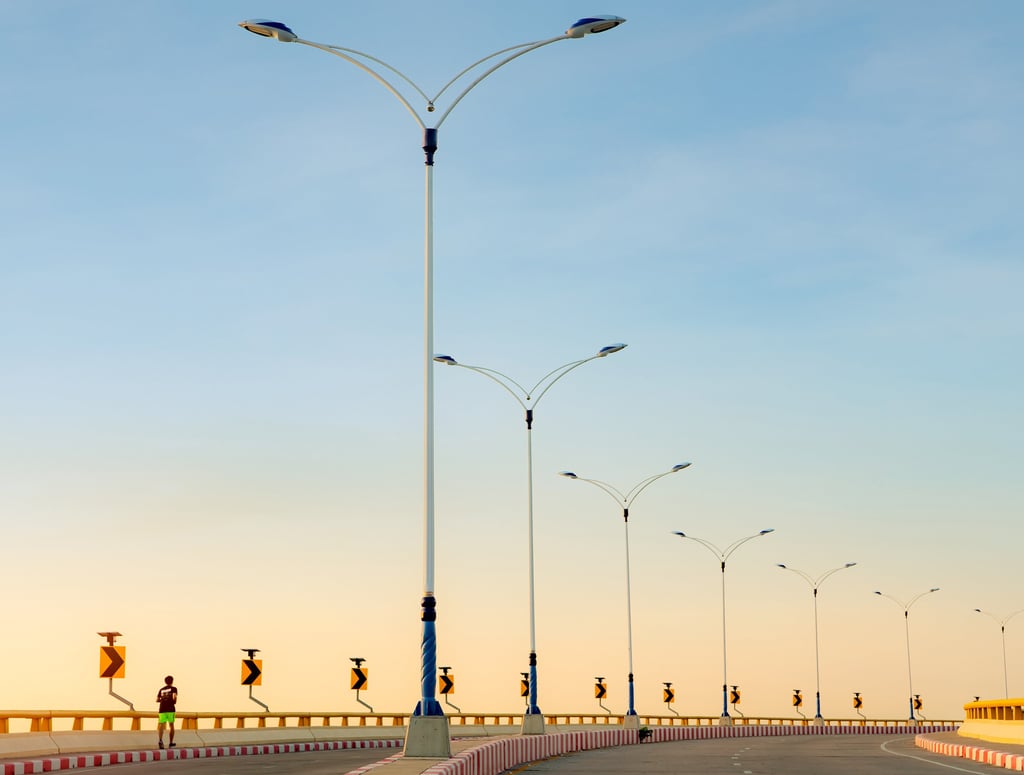
In Public Street Lighting (PJU) systems, the durability of street light poles is a critical factor for long-term safety and efficiency. One of the most effective protective technologies widely used today is the galvanized coating. So, what exactly is the galvanized layer on PJU poles, and why does it prevent rust for decades? Here’s a clear and complete overview.
What Is a Galvanized Coating?
A galvanized coating is a protective layer of zinc applied to steel or iron surfaces through a specialized process. Its main purpose is to protect the base material from corrosion caused by exposure to water, air, moisture, and environmental pollutants.
On PJU poles, this zinc layer acts as the primary shield, ensuring the structure remains strong and rust-free even after many years of outdoor exposure.
The Galvanization Process for PJU Poles
The most common and effective method for street light poles is Hot-Dip Galvanizing:
Hot-Dip Galvanizing The steel pole is immersed in molten zinc at around 450°C.
Key steps include:
Surface cleaning to remove oil, grease, and dirt
Pickling (acid treatment) to remove rust and scale
Fluxing to prepare the surface
Immersion in molten zinc
Cooling, inspection, and quality control
This creates a thick, metallurgically bonded zinc-iron alloy layer that protects even internal surfaces and hard-to-reach areas.
(Electro-galvanizing, which uses electricity to deposit a thinner zinc layer, is less common for outdoor PJU poles as it offers lower corrosion resistance.)
Why Galvanized Coating Provides Excellent Rust Protection
The superior performance comes from three main mechanisms:
Physical Barrier Protection The zinc layer completely isolates the steel from oxygen, moisture, and corrosive elements in the environment.
Cathodic (Sacrificial) Protection Zinc is more electrochemically active than steel. If the coating is scratched or damaged, the zinc corrodes preferentially (“sacrifices” itself), protecting the underlying steel from rust—even in exposed areas.
Uniform and Comprehensive Coverage Unlike paint or powder coating, hot-dip galvanizing coats every surface, edge, weld, and internal section evenly, leaving no unprotected spots.
Key Advantages of Galvanized PJU Poles
Exceptional long-term rust and corrosion resistance (often 20–50+ years depending on environment and coating thickness)
Very low maintenance requirements and costs
High resistance to harsh weather, humidity, salt, and pollution
Environmentally friendly (zinc is recyclable)
Professional, uniform silver-gray finish that ages gracefully
Common Standards for Galvanized PJU Poles
To ensure reliable performance, galvanization typically follows these standards:
SNI (Indonesian National Standard)
ASTM A123 (Standard Specification for Zinc (Hot-Dip Galvanized) Coatings on Iron and Steel Products)
ISO 1461 (Hot dip galvanized coatings on fabricated iron and steel articles)
These specify minimum zinc coating thickness (usually 85–100+ microns for outdoor structural use) to guarantee decades of protection.
Conclusion
The galvanized coating is the key to the long-lasting, rust-resistant performance of PJU poles. Through hot-dip galvanizing, these poles can endure extreme outdoor conditions—rain, heat, pollution, and humidity—while maintaining structural integrity with minimal upkeep. This makes galvanized PJU poles a smart, durable, and cost-effective solution for reliable public street lighting.
Head Office
Jakarta Industrial Estate Pulogadung (JIEP)
Jl. Rawa Gelam 3, Blok. M No. 6, Jatinegara, Cakung, East Jakarta - 13930
Telp : +6221 – 460 1088
Fax : +6221 – 4682 3636
Email : info@dutahitajaya.co.id
© 2026. All rights reserved.
Fabrication Plants
Plant Tambun
Jl. Kampung Bulu No.29, Setiamekar, Tambun Selatan, Kab. Bekasi
West Java - 17510
Plant Setu
Jl. Raya Setu No. 09, Telajung, Cikarang Barat, Kab. Bekasi
Plant Cileungsi
Jl. Raya Narogong KM 24.5, Klapanunggal, Cileungsi, Kab. Bogor
West Java - 16820
Plant Cikarang
Jababeka II Industrial Plant, Jl. Industri selatan VIII, Block EE-7H, Pasirsari, Cikarang Selatan, Kab. Bekasi
West Java - 17534
Galvanize Plant
Our Instagram
West Java - 17530