


The Role of Steel Fabrication in Supporting Modern Building Construction
Building Construction

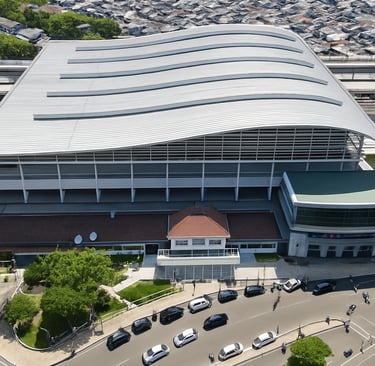
The development of building construction has driven the use of materials that can meet design requirements, construction efficiency, and operational conditions. Steel is one of the widely used materials, particularly for industrial buildings, warehouses, hangars, and commercial facilities.
Steel allows structural components to be manufactured in various shapes and dimensions according to project requirements. However, before being installed at the construction site, the material must undergo fabrication processes to ensure that each component conforms to the structural design.
Steel Components in Building Construction
In building construction, steel can be used for columns, main beams, secondary beams, roof frames, and structural bracing. The materials used vary, including WF sections, H-Beams, channel sections, angle bars, and steel plates.
Each component has its own function and specifications. For example, columns support structural loads, while beams help transfer loads to other supporting elements. The connections between these components are determined through structural calculations before fabrication begins.
Read More : What is Fiber Optic Pole? Function and Specification
Fabrication Determines Component Readiness
The fabrication process begins with material preparation based on engineering drawings. Steel sections and plates are cut to the required dimensions, followed by drilling, forming, and welding where necessary.
Dimensional accuracy is essential because each component must be installed in its designated position. Errors in section length, cutting angles, or bolt hole positions can affect the assembly process at the construction site.
Once fabrication is completed, components must be inspected to ensure that their dimensions, connection conditions, and workmanship meet the project specifications.
Selecting Surface Protection According to Environmental Conditions
Steel buildings require surface protection suitable for their operating environment. Exposure to rain, moisture, and certain industrial conditions can increase the risk of corrosion.
Anti-corrosion coating systems are commonly used to protect steel surfaces. In addition, galvanizing may be applied to specific components depending on the design requirements and project specifications.
The selection of a protection method should consider environmental conditions as well as the building's maintenance requirements.
Steel Fabrication for Various Building Applications
Every construction project has different characteristics, including building dimensions, space requirements, and structural needs. Therefore, fabrication processes must follow the approved engineering drawings and specifications.
Through controlled material processing and quality inspections at every stage, steel components can be prepared to support the construction of various facilities. Fabrication accuracy plays an important role in ensuring that each element is ready for assembly according to the construction design.
Head Office
Jakarta Industrial Estate Pulogadung (JIEP)
Jl. Rawa Gelam 3, Blok. M No. 6, Jatinegara, Cakung, East Jakarta - 13930
Telp : +6221 – 460 1088
Fax : +6221 – 4682 3636
Email : info@dutahitajaya.co.id
© 2026. All rights reserved.
Fabrication Plants
Plant Tambun
Jl. Kampung Bulu No.29, Setiamekar, Tambun Selatan, Kab. Bekasi
West Java - 17510
Plant Setu
Jl. Raya Setu No. 09, Telajung, Cikarang Barat, Kab. Bekasi
Plant Cileungsi
Jl. Raya Narogong KM 24.5, Klapanunggal, Cileungsi, Kab. Bogor
West Java - 16820
Plant Cikarang
Jababeka II Industrial Plant, Jl. Industri selatan VIII, Block EE-7H, Pasirsari, Cikarang Selatan, Kab. Bekasi
West Java - 17534
Galvanize Plant
Our Instagram
West Java - 17530