

Steel Truss Bridge Connections: Small Details That Ensure Structural Accuracy
Bridge

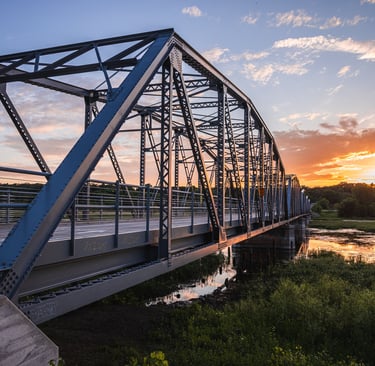
Steel truss bridges are characterized by interconnected steel members arranged in triangular patterns. This configuration is not merely a visual feature but part of a structural system designed to distribute loads through individual components.
During fabrication, attention must be given not only to the main steel members but also to connection details, bolt hole positions, and the dimensional accuracy of each component. These factors play an important role in ensuring that all parts can be assembled according to the structural design.
Connections Must Follow Engineering Drawings
Connections in steel truss bridges may use bolts, welding, or a combination of methods, depending on the structural design and project specifications.
Connection plates, for example, must be manufactured with the correct dimensions and hole patterns. Hole positions need to be accurate so that steel members can be joined at their designated points. Even minor dimensional discrepancies can complicate installation and require further inspection before assembly can proceed.
For this reason, engineering drawings serve as the primary reference for cutting, drilling, and other fabrication processes. Any modifications must follow the applicable technical approval procedures rather than being made solely to force components to fit on-site.
Read Also: The Importance of Dimensional Precision in Electrical Transmission Tower Fabrication
Dimensional Accuracy of Every Component
Steel truss bridge components have different lengths, angles, and connection positions. Diagonal members, horizontal members, and supporting elements must be manufactured according to the dimensions specified in the engineering drawings.
During fabrication, dimensional inspections help verify that components meet the required tolerances. Weld quality, bolt hole conditions, and material conformity must also be inspected in accordance with the project specifications.
This level of accuracy is important because each component functions as part of an integrated structural system. Proper alignment between components supports accurate assembly and helps ensure that the completed structure conforms to the approved design.
Steel Protection for Long-Term Performance
Bridges exposed to outdoor environments face rain, moisture, and other environmental conditions that can contribute to corrosion. Therefore, corrosion protection must be considered as part of the project specifications.
Protection methods may include hot-dip galvanizing or other coating systems appropriate to the design requirements and operating environment. Surface preparation, coating quality, and final inspection must be carried out in accordance with the applicable requirements.
The Role of Steel Fabrication in Bridge Construction
Steel truss bridges are the result of several interconnected stages, from structural design and material selection to fabrication and on-site assembly. Accuracy at each stage helps ensure that components meet the specified engineering requirements.
By maintaining dimensional accuracy, connection quality, fabrication standards, and appropriate surface protection, steel fabrication plays an important role in producing bridge components that meet construction needs and project specifications.
Head Office
Jakarta Industrial Estate Pulogadung (JIEP)
Jl. Rawa Gelam 3, Blok. M No. 6, Jatinegara, Cakung, East Jakarta - 13930
Telp : +6221 – 460 1088
Fax : +6221 – 4682 3636
Email : info@dutahitajaya.co.id
© 2026. All rights reserved.
Fabrication Plants
Plant Tambun
Jl. Kampung Bulu No.29, Setiamekar, Tambun Selatan, Kab. Bekasi
West Java - 17510
Plant Setu
Jl. Raya Setu No. 09, Telajung, Cikarang Barat, Kab. Bekasi
Plant Cileungsi
Jl. Raya Narogong KM 24.5, Klapanunggal, Cileungsi, Kab. Bogor
West Java - 16820
Plant Cikarang
Jababeka II Industrial Plant, Jl. Industri selatan VIII, Block EE-7H, Pasirsari, Cikarang Selatan, Kab. Bekasi
West Java - 17534
Galvanize Plant
Our Instagram
West Java - 17530