

Grinding in Steel Fabrication: Precision in Smoothing Welded Joints and Surface Finishing
Steel Fabrication

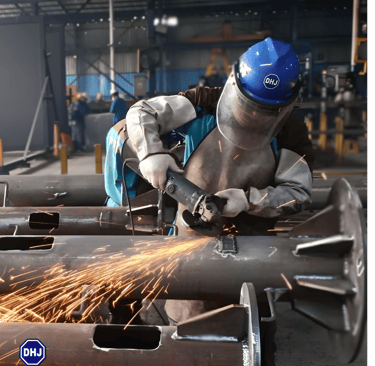
In steel fabrication, cutting, forming, and welding processes produce components that require inspection and additional finishing work. One of the commonly performed stages is grinding, particularly for smoothing material edges and welded joint areas.
Although it may seem like a simple task, grinding requires precision. Excessive or uneven material removal can alter the shape of a component and affect its compliance with the specified requirements.
Grinding After Cutting and Welding
After steel plates are cut using cutting machines, some edges may still contain burrs or excess material. Grinding is used to remove these imperfections and produce cleaner, smoother edges.
In welding work, grinding may also be used to remove weld spatter and smooth specific areas of the joint surface. This process is carried out only where necessary, rather than removing the entire weld indiscriminately. The shape and dimensions of the weld must still comply with the applicable technical requirements.
Maintaining Component Dimensional Accuracy
One important aspect of grinding is maintaining the original dimensions of the material. Steel components are generally manufactured according to engineering drawings that specify their dimensions, thickness, and connection details.
Excessive grinding can reduce the thickness of a plate or welded joint. This may cause the component to fall outside the required specifications. Therefore, operators must understand which areas need finishing and which parts must not undergo significant material removal.
Read Also: What Is Pertashop? A Complete Guide to Its Development and Supporting Infrastructure
Inspecting Grinding Results
After grinding is completed, the surfaces and connection areas must be inspected. The inspection may cover material edge conditions, surface smoothness, and the conformity of component dimensions with the engineering drawings.
For welded joints, visual inspection is still necessary to ensure that no surface conditions violate the project requirements. If any discrepancies are identified, corrective actions must follow the established procedures.
Finishing as Part of Steel Fabrication Quality
Grinding is one of the supporting processes used to maintain the quality of steel fabrication. Proper grinding helps prepare components for subsequent processes, such as painting, anti-corrosion coating, or on-site assembly.
By paying attention to grinding techniques, equipment conditions, and inspection procedures, this process helps produce steel components with cleaner finishes, greater dimensional accuracy, and better conformity with construction requirements.
Head Office
Jakarta Industrial Estate Pulogadung (JIEP)
Jl. Rawa Gelam 3, Blok. M No. 6, Jatinegara, Cakung, East Jakarta - 13930
Telp : +6221 – 460 1088
Fax : +6221 – 4682 3636
Email : info@dutahitajaya.co.id
© 2026. All rights reserved.
Fabrication Plants
Plant Tambun
Jl. Kampung Bulu No.29, Setiamekar, Tambun Selatan, Kab. Bekasi
West Java - 17510
Plant Setu
Jl. Raya Setu No. 09, Telajung, Cikarang Barat, Kab. Bekasi
Plant Cileungsi
Jl. Raya Narogong KM 24.5, Klapanunggal, Cileungsi, Kab. Bogor
West Java - 16820
Plant Cikarang
Jababeka II Industrial Plant, Jl. Industri selatan VIII, Block EE-7H, Pasirsari, Cikarang Selatan, Kab. Bekasi
West Java - 17534
Galvanize Plant
Our Instagram
West Java - 17530